

Castor oil or Arandi ka Tel
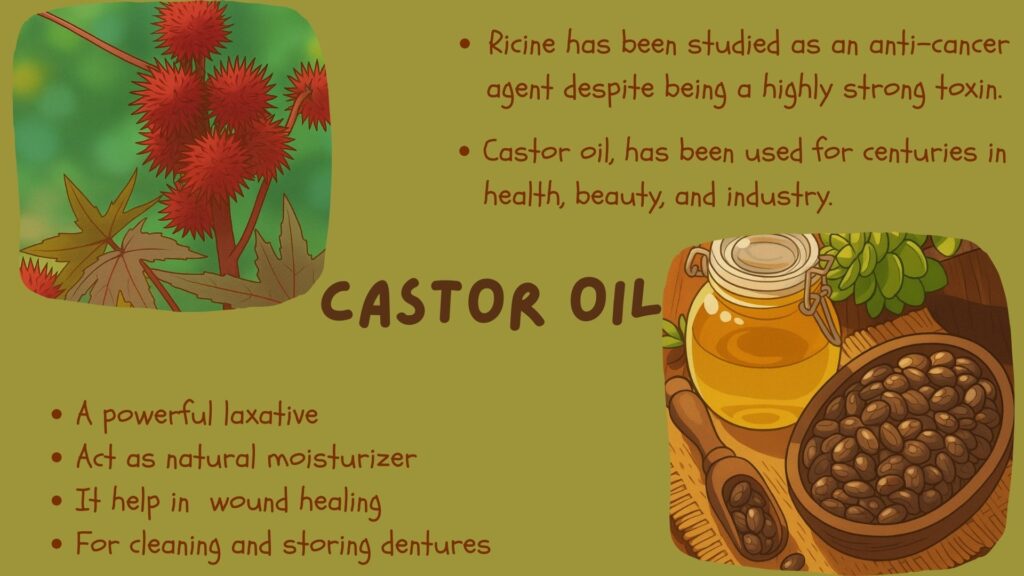
Castor Oil has been used for centuries in health, beauty, and industry. In Ayurveda, it is called Eranda Taila and is valued for balancing the body, cleansing from within, and healing aches and inflammations.
But it’s not just the oil – every part of the plant has benefits for humans:
- Seeds give the powerful oil.
- Leaves are used in traditional remedies for swelling and lactation.
- Roots support nerve health in folk medicine.
- Stem offers fibers for practical uses.
- Flowers help nature by attracting pollinators.
- From soothing joint pains to nourishing skin and hair, and even finding a place in industries like soaps, paints, and biodiesel, castor has touched human life in countless ways.
That’s why castor isn’t just a plant—it’s a gift that connects ancient wisdom with modern needs.
Related article: Turmeric: Indian Saffron
Castor Plant: Other Names
Castor bean (Ricinus communis) also known as as palma Christi, Arandi, or castor bean which is the source of ricin.
Castor plant origin and distribution
The plant may have originated in Africa and Asia, and it is currently found in temperate, subtropical, and tropical regions.
How castor oil has been used for centuries in health, beauty, and industry?
Archaeological discoveries like that of the Border Cave in South Africa provide proof that the castor plant has been used from the beginning of time.
Around 24,000 years ago, a slender wooden stick that was thought to have been used as a poison applicator was discovered to include traces of wax that contained ricinoleic and ricinelaidic acids.
In ancient Egypt, Ebers Papyrus, an Egyptian medical text from before 1500 BCE, mentioned the castor bean, as a laxative, an abortifacient, a cure for baldness, abscessual disease, and other conditions.
The ancient Egyptians were aware of the toxicity of castor beans/
They avoid to use castor in large quantities when making medicine preparations for oral use.
An infant who may have had diabetes was prescribed a medication made from castor seeds to treat a urinary condition.
In the Hearst Papyrus, several portions of the castor plant are listed as ingredients in some prescriptions for internal use to help flush out fluid buildup or encourage diuresis, as well as external usage as bandage poultices.
Around 400 BCE, Hippocrates, the founder of western medicine, recommended castor bean oil for its laxative and cleansing properties.
Castor seeds can be used as an expectorant, diuretic, emetic, laxative, anti-inflammatory, and to treat burns, varicose veins, erysipelas, and other conditions, according to the Greek herbalist and physician Pedanius Dioscorides (40–90 CE) in De Materia Medica.
Castor seeds were recommended for their anthelmintic properties in Chinese traditional medicine.
The latex was injected into the ear to cure rhinitis, while the seed poultice and leaf juice were applied externally to ulcers and chronic wounds.
Castor root is used for skin conditions in Yunani medicine.
The leaves are applied to burns and used to increase the production of breastmilk.
The seeds and oil have purgative properties and are helpful for liver problems, pains, lumbago, boils, piles, ringworm, inflammation, ascites, asthma, rheumatism, dropsy, and amenorrhea.
In veterinary medicine, ground castor seeds or leaf paste have been used to treat wounds, sprains, and edema.
The castor plant is used in Ayurveda to treat rheumatic problems, as well as skin illnesses, colic, lumbago, ascites, bronchitis, cough, inflammation, fever, and gastropathy.
What is castor oil?
Castor oil is derived from the seeds of the castor plant and is used extensively for its industrial, medicinal, and purgative qualities.
Castor oil is a thick, pale yellow liquid that is derived from seeds and used in a variety of industries, skin care products, and purgatives.
What is the Benefits and Uses of Castor Oil ?
A Powerful Laxative
The Food and Drug Administration (FDA) has approved castor oil for use as a natural laxative, and its use is well-known.
It is useful for short-term constipation treatment or bowel cleansing prior to medical procedures.
Note: Excessive use of castor oil may result in adverse effects like diarrhea and cramps in the abdomen. It should never be used without consulting with a healthcare provider.
Natural moisturizer
Ricinoleic acid, which has moisturizing qualities, is abundant in castor oil.
It can be used as a moisturizers, either by itself or in combination with other oils.
It is safe for the face and body and doesn’t contain any dangerous ingredients like commercial treatments do.
Note: Before applying it to larger regions of the skin, test it on a small skin patch and always dilute it with a carrier oil, such as coconut oil, as it may trigger allergic reactions in certain people.
Reduce skin inflammation
By preventing drying out and fostering a moist environment, castor oil can aid in the healing of wounds.
The primary fatty acid in castor oil, ricinoleic acid, help in wound healing, lessen pain, and assist in reducing skin inflammation.
Note: Topical castor oil wound treatments are made up of more than just castor oil. Castor oil should never be applied to any wound without first consulting a medical professional.
Protect from bacterial and fungal infection
Candida fungus are among the many bacteria and fungi that frequently grow on dentures. If dentures are not cleaned and stored correctly, this may lead to oral health issues.
Due to their propensity to stick to denture surfaces and oral tissues, few Candida fungus pose a threat to denture wearers.
An illness known as denture stomatitis, which causes inflammation, redness, and irritation in the mouth, can result from an overabundance of Candida fungi.
However, because castor oil can help kill bacteria and fungi, some study indicates that using it to clean dentures may help lower the chance of having denture stomatitis.
Precautions before using Castor Oil
Castor oil is occasionally used by medical experts to induce labor in pregnant women. Because of this, castor oil should not be consumed by anyone during any stage of pregnancy.
Although castor oil can be a useful remedy for constipation, it can also use in cramps, bloating, vomiting, and diarrhea.
It could also make you feel lightheaded. Use it only under a doctor’s supervision for constipation.
Castor oil and other stimulative laxatives should be avoided by those with inflammatory bowel disease (IBD), appendicitis, gastrointestinal obstruction, and bowel perforation because they may have severe adverse effects.
It can be harmful if misused, and it should never be used to treat any medical problem unless prescribed by a doctor. Before using it for any health issue or symptom, speak with a healthcare provider.
Secondary Metabolites in Castor Plants Seeds, Leaves, Roots, Stem and Flowers
Castor Seeds
Oil content (40–60%): Ricinoleic acid (90%), linoleic acid, oleic acid, palmitic acid.
- Alkaloid: Ricinine.
- Toxic protein: Ricin.
- Sterols: β-sitosterol, stigmasterol.
Importance: castor oil (laxative, industrial uses), ricin (toxin, research), ricinine (insecticidal).
What is ricin?
The seeds are highly toxic, therefore keep plants out of children’s reach.
Ricine (RYE-sin), one of the most lethal natural poisons, is found in castor seeds.
It is thought to be 12,000 times more toxic than rattlesnake venom and 6,000 times more toxic than cyanide.
Smaller doses will cause convulsions, vomiting, diarrhea, and excruciating stomach agony.
Ricine has been studied as an anti-cancer agent despite being a highly strong toxin.
Since ricin is water soluble rather than lipid (oil) soluble, it is retained in the remaining “seed cake” after pressing.
Once the residue has been detoxicated, the meal can be utilized as animal feed or as a high-nitrogen fertilizer.
What happened if you consume castor bean ?
It is rare to become poisoned by castor beans. Because of their thick coat, ricin cannot escape.
When the seeds are eaten or crushed before being swallowed, toxicity occurs.
After eating crushed or chewed castor beans, one may experience nausea, vomiting, diarrhea, and stomach pain.
Gastrointestinal bleeding may occur from the shedding of the cells lining the digestive tract.
Loss of fluid and electrolytes can cause shock and even death.
At the cellular level, several organs, including the liver, brain, and kidneys, may also be impacted and may even shut down.
Note: Because of life support and improved medical treatment, deaths from castor beans are uncommon these days.
This might not be the case, though, in special circumstances where ricin is used as a bioterrorism agent, like in the murder of Bulgarian author Georgi Markov.
A few days later, Markov was killed after being shot in the leg with a pellet that contained ricin.
Castor Leaves
Secondary metabolites: gallic, ellagic, gentisic, chlorogenic, caffeic acids.
Medicinal Properties: These phenolic compounds contribute to the leaves’ recognized anti-inflammatory and antioxidant activities.
Traditional Uses: Due to their phytochemical content, castor leaves have been used in traditional medicine for various health-related issues.
Secondary metabolites: quercetin, rutin, kaempferol, epicatechin
Medicinal Properties: These flavonoids contribute to the plant’s medicinal properties, with compounds like rutin demonstrating antioxidant, anti-diabetic, and anti-hypertensive effects.
Castor Roots
Secondary metabolit: Triterpenoids (Lupeol)
Lupeol has been found in the roots of castor plants, although it is primarily found in the epidermal wax on the stems and aerial organs. Along with other unidentified triterpenes, lupeol is a major chemical that was isolated from the roots of the castor plant, despite being present in smaller concentrations in the roots than in the aerial surfaces. Since lupeol is a pentacyclic triterpenoid of the lupane type and has a variety of pharmacological characteristics, its presence in the roots is of scientific interest for possible uses.
Castor Stem & Flowers
Secondary metabolites: Sterols: stigmasterol, β-sitosterol
Antimicrobial Properties: Both β-sitosterol and stigmasterol have demonstrated antimicrobial properties, with the potential to contribute to a plant’s defense mechanisms.
Metabolic Properties: In addition to their involvement in plant metabolism, these phytosterols have been demonstrated in other studies to have the ability to modify lipid metabolism and influence cellular pathways such as AMPK activation.
Although more research is required, the existence of these sterols in medicinal plants supports their usage in traditional treatments and highlights their potential health advantages.
Read article: