

Cerebral Palsy
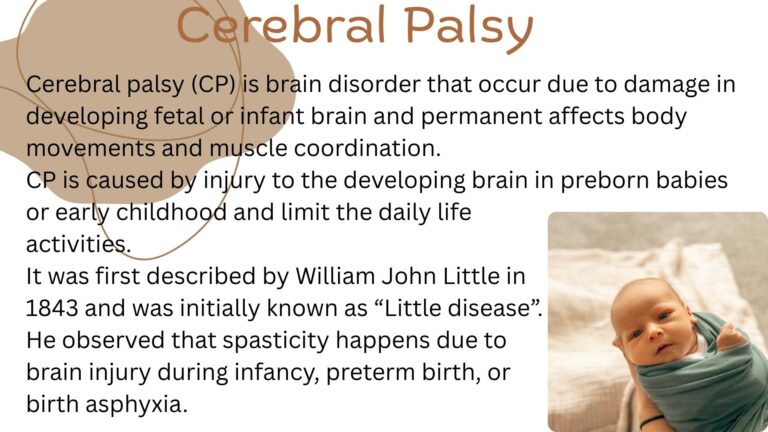
Cerebral palsy (CP) is brain disorder that occur due to damage in developing fetal or infant brain and permanent affects body movements and muscle coordination. CP is caused by injury to the developing brain in preborn babies or early childhood and limit the daily life activities.
It was first described by William John Little in 1843 and was initially known as “Little disease”. He observed that spasticity happens due to brain injury during infancy, preterm birth, or birth asphyxia.
Related article: Cerebral Palsy: Causes, Symptoms, classifications
Risk factors
Although prematurity and low birthweight are main risk factors for CP, multiple other factors are also associated with or potentially increase the risk for CP.
Risk factors before birth
Before birth there are various risk factor that can increase the chance of CP and these are:
Premature birth– Birth of a baby before 37 weeks of pregnancy. Premature babies have immature brains, which increases the risk of brain injury.
Low birth weight– A baby weighing less than 2.5 kg (2500 g) at birth. Low weight may indicate poor fetal development.
CNS malformation– Abnormal development of the central nervous system (brain and spinal cord) before birth.
Maternal Diabetes Mellitus– When the mother has diabetes during pregnancy, which can affect fetal brain development.
Prolonged rupture of membrane-When the amniotic sac breaks many hours before delivery, increasing the risk of infection.
Maternal hemorrhage– Severe bleeding in the mother during pregnancy, which can reduce oxygen supply to the fetus.
Multiple gestations– Pregnancy with more than one fetus, such as twins or triplets. These pregnancies have higher complication risks.
Cotwin death– In a twin pregnancy, one fetus dies while the other survives, which can affect the surviving baby’s brain.
Genetic factors– Changes or mutations in genes that affect brain development.
Encephalopathy of prematurity– Brain damage occurring in premature infants, usually due to immature brain development or lack of oxygen.
Congenital malformation– Structural abnormalities present at birth, especially affecting the brain.
Hypoxic-ischemic encephalopathy– Brain injury caused by lack of oxygen and blood flow to the brain during pregnancy or delivery.
In utero stroke- A stroke occurring in the fetus while still in the uterus, affecting brain blood supply.
In vitro fertilization (IVF)- A fertility treatment where fertilization occurs outside the body. IVF pregnancies have slightly higher risks of prematurity.
Kernicterus– Severe brain damage caused by very high levels of bilirubin in newborns.
Maternal disorder of clotting– Blood clotting problems in the mother that may affect blood flow to the placenta and fetus.
Meconium aspiration– When the baby inhales meconium (first stool) into the lungs before or during birth, causing breathing problems.
Fetal growth restriction (FGR)- The fetus does not grow at the normal rate in the uterus.
Preeclampsia– A pregnancy complication with high blood pressure and organ damage in the mother, affecting blood supply to the fetus.
Risk factors during birth
Premature birth- The baby is born before 37 weeks of pregnancy. Premature babies have an immature brain that is more vulnerable to injury.
C-section (Cesarean section)- A surgical procedure used to deliver a baby through cuts in the mother’s abdomen and uterus when normal vaginal delivery may be risky.
Vacuum-assisted delivery– A delivery method where a soft cup attached to a vacuum device is placed on the baby’s head to help pull the baby out during difficult labor.
Delivery after the due date– Birth that occurs after 42 weeks of pregnancy (post-term delivery). This may increase complications such as reduced oxygen supply to the baby.
Prolonged labor– Labor that lasts unusually long, usually more than 20 hours for first-time mothers or more than 14 hours for experienced mothers. Long labor can increase stress and oxygen problems for the baby.
Asphyxia– A condition where the baby does not receive enough oxygen before, during, or immediately after birth, which may cause brain injury.
Meconium aspiration- The baby breathes in meconium (the baby’s first stool) mixed with amniotic fluid, which can block airways and reduce oxygen supply.
Breech vaginal delivery- A delivery where the baby comes out feet-first or buttocks-first instead of head-first, which can make delivery more difficult.
High fever during delivery– If the mother has a high fever during labor, it may indicate infection that could affect the baby.
Perinatal stroke– A stroke occurring shortly before, during, or soon after birth, caused by interrupted blood flow to the baby’s brain.
Risk factors after birth
Hypoxic-ischemic encephalopathy (HIE)– A type of brain injury caused by lack of oxygen and reduced blood flow to the brain after birth.
Infection– Any bacterial, viral, or fungal infection that affects the baby and may damage the brain.
Hyperbilirubinemia– A condition where bilirubin levels in the blood become very high, causing severe jaundice and possibly brain damage.
Cerebrovascular accidents– Commonly called stroke, where blood supply to a part of the brain is blocked or interrupted.
Intracranial hemorrhage– Bleeding inside the brain or skull, which can injure brain tissue.
CNS infection– Infections affecting the central nervous system (brain and spinal cord).
Respiratory distress– When a newborn has difficulty breathing, leading to low oxygen levels in the body.
Artificial respiratory support– Use of machines such as ventilators to help a baby breathe when they cannot breathe adequately on their own.
Hypoglycemia– A condition where blood sugar levels are dangerously low, which can harm the brain.
Neonatal convulsions– Seizures occurring in newborn babies, often due to brain injury or metabolic problems.
Traumatic brain injury– Brain damage caused by physical injury to the head, such as accidents or falls.
Near drowning– A situation where a baby or child almost drowns, leading to oxygen deprivation to the brain.
Meningitis– A serious infection causing inflammation of the protective membranes covering the brain and spinal cord.
Sepsis– A severe body-wide infection where bacteria enter the bloodstream and cause life-threatening complications.
Neonatal encephalopathy– A condition where a newborn shows abnormal brain function, such as poor muscle tone, seizures, or difficulty breathing.
Other risk factors
In some cases of CP, areas of brain responsible for muscle movement do not develop properly in womb. In other cases, brain is damaged due to injury before birth, during delivery, or after the baby is born.
In some cases, sudden genetic mutations in genes are also one of the reasons for CP, even when there are no other known causes such as birth injury, infection, or lack of oxygen.
Other common factors that leads to CP are placenta abruption, prolapsed cord, birth asphyxia, congenital anomalies, and maternal conditions during labor like high fever.
CP Diagnosis methods
Monitor and observation
Most children with CP are identified and diagnosed before the age of two years. However, if the symptoms are mild, the signs may not be very obvious in infancy. In such cases, doctors may not diagnose cerebral palsy until the child is older.
To find out whether a child has cerebral palsy, doctors perform several tests and regularly observe the child’s development and physical abilities such as muscle tone, motor control, hearing vision, posture and coordination. These tests observe and identify the signs of CP and rule out other disorders.
Lab tests
Ultrasound- An ultrasound scan is often used in high-risk premature babies. Doctors use it to look for brain abnormalities or bleeding.
MRI (Magnetic Resonance Imaging)- It helps doctors identify the location and type of brain damage. It can detect changes in white matter, which is commonly affected in cerebral palsy.
EEG (Electroencephalogram)- It detects abnormal electrical patterns, may indicate seizures, which can occur in some children with CP.
Treatments
There is no permanent cure for cerebral palsy because the brain injury that causes the condition cannot be completely reversed. However, different treatments can help improve movement, function, and quality of life.
For treatment various therapies such as neurorestorative therapies, rehabilitation programs, and sometimes surgery can help improve the child’s abilities and quality of life.
Proper nutrition during pregnancy
If a pregnant woman consumes a balanced diet containing essential nutrients (such as proteins, vitamins, minerals, and folic acid), it helps support healthy fetal brain development. Good maternal nutrition can reduce the risk of problems that may lead to cerebral palsy.
Early detection in children
If cerebral palsy is identified early in a child’s life, treatment and therapy can start sooner.
Early stimulation therapies
Doctors and therapists may use sensory stimulation techniques to support brain development, including:
Visual stimulation – activities that encourage the child to focus on objects and improve vision.
Auditory stimulation – exposure to sounds or speech to stimulate hearing and communication.
Tactile stimulation – touch-based therapy to improve sensory and motor responses.
Smell (olfactory) stimulation – exposure to different smells to stimulate sensory pathways.
Activities
Children with CP often participate less in school activities compared to typically developing children. Their school engagement mainly depends on abilities related to early learning skills, communication, mobility, and social interaction, according to parents’ observations.
Treatment approaches have also evolved. Earlier therapies mainly focused on improving joint movement and muscle strength, but modern approaches emphasizes improving practical daily activities and functional task performance to enhance participation in real-life situations.
Neurologic music therapy
Recent rehabilitation approaches for CP include innovative therapies that improve motor and learning abilities. Neurologic music therapy helps enhance rehabilitation by linking motor and cognitive functions, making learning and movement training more effective. In addition, Virtual Reality–based interventions have improved treatment outcomes in medical rehabilitation, while robot-assisted gait training helps improve walking ability and locomotion patterns in children with CP.
Neurorestorative therapy
The field of Neurorestoratology focuses on improving the quality of life of people with neurological disorders and injuries, including conditions like CP. Unlike Regenerative Medicine, which mainly aims to regenerate damaged nerve cells, neurorestoratology includes a broader range of neurorestorative therapies designed to help patients regain lost functions and improve daily living abilities.
Physical, speech, and occupational therapy
Physical therapy
Physical therapy, especially during the first few years of a child’s life, plays a major role in managing cerebral palsy. Early therapy helps improve the child’s movement and physical abilities.
Physical therapy includes stretching exercises, resistance training and strength training .
Speech and language therapy
Speech and language therapy helps improve a child’s ability to speak, communicate, and swallow food safely.
It improves speech skills, helping children pronounce words and express themselves better.
It treats swallowing disorders, which can make eating or drinking difficult. It teaches alternative ways to communicate, such as, sign language, assistive communication devices, like a computer with a voice synthesizer that speaks words for the child.
Occupational therapy focuses
Occupational therapy helps children improve their ability to perform daily activities and use their movement abilities as effectively as possible. Therapists teach children new and easier ways to perform everyday tasks, such as: dressing and personal care, eating and using utensils, writing and school activities, playing and interacting with others.
Recreational therapy
Recreational therapy uses fun and enjoyable activities to support a person’s physical and mental development.
Drug treatments
Medications are used to manage symptoms in CP, particularly muscle stiffness. Muscle-relaxing drugs such as Diazepam, Baclofen, Dantrolene sodium, and Tizanidine help reduce muscle tone and relieve pain, especially in children with mild or widespread stiffness.
In children with spastic CP, Botulinum toxin injections can temporarily relax targeted muscles for about three months, particularly when combined with physical therapy and splints. For severe and widespread muscle stiffness, Intrathecal Baclofen Therapy uses an implanted pump to deliver baclofen directly into the spinal fluid, allowing better control of muscle tone throughout the day.
Surgery
Surgery may be recommended for some people with CP when severe muscle stiffness and spasticity make walking painful or difficult. Surgical procedures can lengthen muscles and tendons to improve mobility and reduce pain. Tendon surgery may benefit some children, although it can have possible long-term effects. In certain cases, surgery is also used to correct or improve spinal deformities, and procedures may be performed gradually according to the child’s age and development.
Assistive devices
People with Cerebral Palsy may use assistive and mobility devices to improve communication, movement, and daily functioning. Communication aids such as computer software, voice synthesizers, and picture boards help enhance communication skills.
Mobility aids like orthotics, splints, special chairs, walkers, and wheelchairs support better movement and posture. Some individuals may also require glasses, vision-correcting surgery, or hearing aids to manage vision and hearing problems.
Complementary and alternative therapies
Some children and adolescents with Cerebral Palsy use complementary or alternative therapies such as dietary supplements or oxygen therapy. Although some families report benefits, these treatments are not approved by the U.S. Food and Drug Administration for CP treatment. Therefore, families should consult their doctor before using any alternative therapies or supplements.
Q & A
Lack of oxygen at birth is responsible for CP?
Yes, earlier it was believed that lack of oxygen at birth is the reason of CP. However, later research showed that many other factor and cause are reasonable for the development of CP.
What is Hypertonicity
Hypertonicity of the muscles is due to the brain injury in cerebral palsy, muscles become stiff and tight, and children may also have difficulty with balance, coordination, and hand movements.
Hypertonicity may be due to three causes, i.e.,
In CP children, more muscle fibre required to perform task than healthy children.
Excess deposition of collagen that makes the muscle stiff and less flexible.
Disturbance in the neuromuscular junction causes a problem in muscle contraction.
Can cerebral palsy be prevented?
Cerebral Palsy cannot always be prevented because some cases are linked to genetic factors. However, certain risk factors can be reduced. For example, vaccination against Rubella before pregnancy can prevent infections that may lead to CP. In addition, acquired CP caused by head injuries can be prevented by using safety measures such as car seats and helmets.
Read article: