

WHAT IS OSTEOARTHRITIS?
Osteoarthritis (OA) is the most common type of arthritis.
The earliest research on osteoarthritis was that it is degenerative diseases. current research has shown that it is a multifactorial and complex disorder, with both infectious and metabolic components contributing to its development.
Experts estimate that osteoarthritis affects more than 80% of persons over the age of 55, even if some never develop symptoms. Around 60% of patients with osteoarthritis have symptoms that they can observe or feel.
In healthy person
The ends of the bones in your joints are covered with a smooth, slippery tissue called cartilage.
This cartilage cushions the bones and allows them to glide effortlessly when the joint moves.
Acting as both a shock absorber and a lubricant, cartilage ensures that the bones in your joints move smoothly and safely past each other.
In Osteoarthritis
The protective cartilage that cushions the ends of bones wears out and becomes rough.
It causes discomfort, stiffness, edema, and restricted movement, particularly in the hands, knees, hips, and spine.
The main outcomes of OA are cartilage degradation, acute and chronic synovial inflammation, subchondral bone modification, the presence of osteophytes, and alterations in synovial fluid.
Osteoarthritis only affects joints, typically in the hands, knees, hips, neck, and lower back. It is the most common form of arthritis.
There is no cure for osteoarthritis. It usually worsens slowly.
While there is no cure, controlling weight, staying active, and sticking to a treatment plan can help slow its growth and improve symptoms.
However, the damage to the joints cannot be reversed. Staying active, maintaining a healthy weight, and receiving some therapies may decrease disease development and improve pain and joint function.
Related Article: Gout: Causes, Symptoms, Pseudogout and Risk Factors
WHAT HAPPENS IN OSTEOARTHRITIS
Cartilage breakdown
In a healthy joint, articular cartilage is a smooth, slippery tissue that covers the ends of bones, allowing them to glide freely during movement.
In osteoarthritis, this cartilage gradually becomes thinner, rougher, and eventually wears away.
Bone friction
As the protective cartilage deteriorates, the underlying bones begin to rub against each other, leading to pain, stiffness, and reduced mobility.
Bone spurs and inflammation
In an attempt to repair the damage, the body forms extra bone growths called bone spurs (osteophytes).
Additionally, inflammation can occur in the surrounding joint tissues, further contributing to pain and swelling.
The most frequently affected joints are:
- Hands (ends of the fingers, base and ends of the thumbs)
- Hips
- Neck
- Knees
- Lower back
Osteoarthritis can cause damage to various parts of the joint, including:
- Cartilage, the tissue that covers the ends where two bones meet to form a joint
- Synovium, the lining of the joint
- Tendons and ligaments
- Bone
- Meniscus in the knee
Osteoarthritis affects each person differently
Some people have moderate osteoarthritis that does not interfere with their daily activities. For others, it causes severe discomfort and disability.
Joint inflammation normally develops over time, but it can worsen quickly in some persons. As soft tissues of the joint degrade, discomfort, edema, and loss of joint motion emerge.
If you are experiencing joint pain, you may be less active, which can lead to muscle weakness and increased stress on the joint. Eventually, the joint may lose its original shape. Small bone growths known as osteophytes or bone spurs can also develop on the joint’s margins.
The shape of the affected bone may also change over time. In some cases, small fragments of bone or cartilage can break off and float within the joint space, causing further irritation and damage.
Researchers continue to investigate the underlying mechanisms of pain in people with osteoarthritis to better understand and manage the condition.
TYPES OF OSTEOARTHRITIS
A healthcare provider might classify osteoarthritis as one of two types:
Primary Osteoarthritis
Primary osteoarthritis is the most common form of osteoarthritis and typically develops gradually over time. Experts believe it results mainly from the natural wear and tear that occurs as joints are used throughout life.
This type of osteoarthritis is strongly associated with aging — in fact, age is considered the most significant risk factor. The longer a person uses their joints, the more likely they are to develop primary OA. It usually begins to appear around the age of 55 to 60.
Primary osteoarthritis may affect specific joints, such as those in the hands, feet, knees, or hips, but it can also involve multiple joints in the body.
Secondary Osteoarthritis
Secondary osteoarthritis develops when a specific factor or condition directly damages a joint, leading to degenerative changes over time.
Unlike primary osteoarthritis, which occurs due to natural aging and wear, secondary OA arises from an underlying cause that alters the joint’s normal structure or environment.
Common causes include joint injuries or trauma, congenital joint abnormalities, metabolic disorders (such as Wilson’s disease), infections, and certain diseases that affect cartilage integrity, such as rheumatoid arthritis or gout.
Secondary osteoarthritis often appears earlier than the primary form, typically in individuals around 45 to 50 years of age.
Read article: Healthy Weight Loss Made Simple: Science-Backed Diet & Exercise
CAUSES AND RISK FACTORS OF OSTEOARTHRITIS
Age
OA can develop naturally as people age. The chance of having OA rises with age, and symptoms usually, but not always, develop in adults over 50.
Obesity
Excess body weight places additional stress on weight-bearing joints, especially the knees and hips.
Even a small increase in body weight can significantly raise the amount of force exerted on the knees during activities like walking.
Over time, this added pressure accelerates the wear and tear of cartilage, contributing to the development and progression of osteoarthritis.
Moreover, fat cells release inflammatory substances that can further damage joint tissues and worsen inflammation.
Joint injury
A history of joint injury can significantly increase the risk of developing osteoarthritis.
Fractures, as well as cartilage or ligament tears, can damage the joint structure and lead to osteoarthritis—often appearing sooner than in individuals without such injuries. As a result, people with previous joint injuries are more likely to develop OA at a younger age compared to those with primary osteoarthritis.
Research also suggests that individuals with OA experience a higher incidence of falls and fractures than those without the condition.
Genetics
Certain genetic variations can increase an individual’s risk of developing osteoarthritis. Studies have shown that family history provides strong evidence of a genetic influence, particularly in osteoarthritis affecting the hands, knees, and hips.
Research have shown that the heritability of OA varies depending on the specific joint involved, but overall, genetics may account for 50% or more of the risk.
Research has also identified associations with specific chromosomal regions (such as 2q, 9q, 11q, and 16p) and genes related to cartilage structure and function, including CRTM (cartilage matrix protein), CRTL (cartilage link protein), and various collagen genes (types II, IX, and XI).
Gender
Women are more likely to develop OA than men.
Sedentary lifestyle
Living sedentary lifestyle promote weight gain and it also leads to weakened muscles and tendons surrounding the joints.
This lack of muscular support increases the risk of developing osteoarthritis, as the weakened muscles are less able to keep the joints properly aligned, stable, and supported.
Joint overuse
When you repeatedly use the same joints—whether at work, in sports, or during hobbies—those joints are subjected to continuous stress.
Over time, the muscles around the joint can become tired and less able to protect the joint properly.
Without strong muscular support, the joint experiences more wear and tear, which increases the risk of developing OA.
Musculoskeletal abnormalities
When bones or joint structures are not properly aligned, it can place uneven stress on the joint, contributing to the faster progression of osteoarthritis.
Other health conditions
Diabetes, high cholesterol (hyperlipidemia), and some autoimmune diseases also raise risk.
COMMON SYMPTOMS OF OSTEOARTHRITIS
Pain
Aches or pain in a joint, often worse during or after activity and improving with rest. Painful joints, especially in the feet, ankles, knees, hip or back, make it harder to exercise.
- Joint pain: Aching or pain in a joint is common, often worsening during or after activity and improving with rest. Pain frequently affects the feet, ankles, knees, hips, or back, making exercise and daily activities more difficult.
- Pain at night: For some individuals, particularly in later stages, joint pain may become more pronounced at night.
- Localized or widespread: Pain can be limited to a single joint or affect multiple areas.
- Activity-related pain: Discomfort typically occurs with movement and tends to ease with rest.
- Indirect complications: Pain, reduced mobility, side effects from medications, and other factors associated with osteoarthritis can lead to additional health issues not directly caused by the disease itself.
Stiffness
- Morning or inactivity stiffness: Joints may feel stiff after periods of inactivity, such as in the morning, but this usually improves within a short time.
- Limited range of motion: You may not be able to move the joint through its full range of motion.
- Tenderness: Joints can feel tender when light pressure is applied to or near them.
Swelling
- Swelling may occur in and around the joint, particularly after periods of activity or heavy use.
- This swelling is often due to inflammation of the soft tissues surrounding the joint.
Reduced Joint Function and Instability
Limited range of motion: Osteoarthritis can reduce the ability to move a joint fully, making bending, straightening, or rotating more difficult.
Joint instability: The joint may feel loose or unstable, and weight-bearing joints like the knee or ankle may buckle or give way.
Mechanical interference: Loose fragments of cartilage can disrupt smooth joint movement, causing the joint to lock or stick.
Sounds from the joint: Arthritic joints may produce creaking, clicking, snapping, or grinding noises, a phenomenon known as crepitus.
Weakening of the joint: Over time, the joint may weaken, further impairing movement and stability.
Grating sensation (Crepitus)
When you move an osteoarthritic joint, you may experience a rough or scraping feeling as the joint surfaces rub against each other.
You might also hear popping, cracking, or crunching sounds (sometimes called crepitus) due to the irregular cartilage or loose fragments inside the joint.
Bone spurs
In osteoarthritis, the body may form extra bone around the joint, known as bone spurs. These hard lumps can sometimes be felt and may contribute to pain or limit joint movement.
Joints Commonly Affected by Osteoarthritis
Hands- Bone enlargements and shape modifications in the finger joints can occur over time.
Knees- When walking or moving, you may notice a grinding or scaping sound. Muscle and ligament weakening might eventually cause the knee to collapse.
A “grating” or “scraping” sensation when moving the knee.
Hips- You may experience pain and stiffness in the hip joint, groin, inner thigh, or buttocks.
Arthritis discomfort in the hip can occasionally migrate to the knees. Over time, you may be unable to move your hip as far as you once could.
Spine- You may notice pain and discomfort in your neck or lower back. As the spine changes, some people develop spinal stenosis, which can cause a variety of symptoms.
Fingers- Bony growths (spurs) around the edges of joints can produce swelling, tenderness, and redness in the fingers, as well as pain at the base of the thumb.
Feet- Pain and discomfort in the big toe, with swelling in the ankles or toes.
HOW OSTEOARTHRITIS IS DIAGNOSED
There is no definitive test for osteoarthritis. To determine if you have osteoarthritis, consult your provider:
- Will observe the symptoms and medical history
- Perform physical examination
- Use x-rays or other imaging tests to look at your joints
- Lab tests to make sure that a different problem isn’t causing your symptoms
Your healthcare professional may utilize X-rays to take images of your joints. They may also employ an MRI (magnetic resonance imaging) or CT scan.
Lab tests
Analyzing blood or joint fluid can help confirm the diagnosis.
- Blood tests
- Joint fluid analysis
Related article: How to Manage Osteoarthritis: Treatment Options, Exercises, and Medications
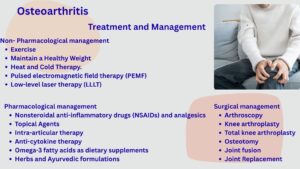
TREATMENT AND MANAGEMENT OPTIONS
Non- Pharmacological management
- Exercise
- Maintain a healthy weight
- Physical therapy (heat and cooling)
- Pulsed electromagnetic field therapy (PEMF)
- Low-level laser therapy (LLLT)
- Massage
- Supportive devices
- Complementary therapy
Pharmacological management
- Nonsteroidal anti-inflammatory drugs (NSAIDs) and analgesics
- Topical agents
- Intra-articular therapy
- Anti-cytokine therapy
- Omega-3 fatty acids as dietary supplements
- Herbs and Ayurvedic formulations
Triphala churna and Triphaghula, along with Balaraja and Dashmoolasa.
Surgical management
- Arthroscopy
- Knee arthroplasty
- Total knee arthroplasty
- Osteotomy
- Joint fusion
- Joint replacement
Read article: How to Manage Osteoarthritis: Treatment Options, Exercises, and Medications
Recommended Products